Group Work, Meta Physical Reality and First Poetry Reading

Group Work

The task was simple enough – as a group of 3 we each had to select a short 1-3 sentence extract for our form of literature and put them together to make a performance with appropriate lighting and sound. As a group we decided to randomly select our short extract because the task itself was seemingly random. We assembled the sentences to create a form of dialog with some element of a plot/emotion/effect.

20140525_213949

(Mighty, 2014) Group work script.*

It seemed like we were hoping to create or find meaning out of this random amalgamation of words, so we experiment. We said the line together, we said the lines separately, we overlapped different lines, and we changed our tempo, rhythm and inflections in the hope that we could create meaning.

(Mighty, 2014) Experimenting with how I say “visited a foward post”.*

During our tech set-up we used lighting and sound as a way of creating meaning. For example we created a playful underwater atmosphere by using blue strip-lighting and the song “Under the Sea” from the movies The Little Mermaid. As the song played we all said the one line that held any reference to the sea and that was “Casson building aquarium”.

(Angela Chan, 2009).

What I find interesting about this experience is that we were constantly looking for and creating meaning where there was none to begin with. I think documentarian Ken Burns puts it best when he says “we superimpose meaning over the chaos, we tell jokes, we tell stories, we put a frame around things and that’s a way of trying to create a narrative about stuff that has no narrative.” This understanding of reality is equally relevant to our group work as we felt that if our performance didn’t have a narrative of some kind it would lack substance.

First Poetry Reading

I tested out the foundations of my new performance Under My Hair as I read 5 poems to the class. There wasn’t any imagery, lighting, sound or narrative, I simply stood at the front of the class reading poetry and believing I had a performance. What was pointed out was that the poems alone held no substance as a performance. Within a stage all forms of reality are heightened, acting becomes louder, personalities become bigger and men and women become heroes and scoundrels. Whereas poetry alone is captivating at an open mic, it is not as captivating when used as a staged performance because the realm of a performance is a heightened reality where meaning and narrative has to be slightly exaggerated. My responsibility as an actor is to find the meaning within the poems by framing them with light, sound and imagery and making them relevant to the audience.


Citations:

Angela Chan (2009). Under The Sea – The Little Mermaid with Lyrics. [online video] Available from https://www.youtube.com/watch?v=BpqdexBnNkM [Accessed 13 April 2014].

Team Coco (2014) Documentarian Ken Burns— Serious Jibber-Jabber with Conan O’Brien. [online video] Available from https://www.youtube.com/watch?v=jCxbCYHVZ7k&list=PLVL8S3lUHf0TIbLusugli-_6OhbvqgMvD&index=2 [Accessed 13 April 2014].

The Seemingly Sacred Performance Space

The Seemingly Sacred Performance Space

Within my last blog my conclusion was that I wanted to couple Realism with In-Yer-Face theatre. The dilemma is to now figure out how I can do this while retaining the overall meaning of the performance. While watching the collection of presentations put on by my fellow class mates, I drew ideas from the soloists that we discussed especially with deep consideration towards the means of creating a realistic performance style. The two soloists that caught my eye are Chris Goode and Rachel Rosenthal. Through using influences from these two soloists I want to ultimately explore ways in which I can change the dynamics of a traditional performance; creating a sense of realism that isn’t confined behind the imaginary 4th wall.

A Thought towards Chris Goode

During Lauren Watson’s presentation on Chris Goode’s Wound Man and Shirley, she pointed out that Goode used a doubled-ended frame narrative within his performance to tell a story. A doubled ended frame narrative is where the performer, Chris Goode introduces the story directly to the audience stating “Hello. Thanks for being here”, which breaks the 4th wall and ends it in much the same manner saying “that’s where we all are, me and all of you” (Goode, 2012, 1). Chris Goode is not a narrator but rather a character from within the story that is depicting the event through his perspective.

(The Camera Hire Company, 2012)

What is significant about this style is that it creates a sense of realism as it doesn’t hide the story behind any dramatics like a 4th wall, sound or music. I did feel that his stage layout which resembled some sort of study area with cluttered table tops, a lamp and a 1 seat couch took away from his performance (The Camera Hire Company, 2012). This is because the double-ended narrative created an environment that is open and direct with the audience while the set only created clutter that distracts and takes attention away from the story.

How I Wish To Incorporate a Double Ended Narrative

Part of me wants to question if there is ever even a 4th wall when you are doing a solo performance, as you are always one with the audience. Unlike performances with multiple actors, when you talk you are only heard by the audience and no other actor. Like it or not, however a solo performance is framed the soloist always talks with the audience. What is apparent is how easy it is to forget this; that whatever meaning that is created on stage is not created to influence fictitious characters but rather the audience, always.

No matter the case my objective it not to simply break the wall but rather to, as Jean Schiffman puts it, “manipulate the audience to feel those moments” (Schiffman, 2006, 10). However the word ‘manipulate’ is not used in a possessive manner but rather to describe elements of a performance that purposely shifts the audiences’ perspectives. I feel that the manner in which I engage my audience will lead to a greater perspective shift. To break the 4th wall by talking directly to my audience is not enough as Steve Nelson says that “the actors say their lines and go through their routines without being unduly affected by what the audience does or does not do” (Nelson, 1989, 93). Since direct speech can equally be as rigid as the imaginary 4th wall I plan to be intimate with my audience in the sense that it is only me and them without staging, lighting, sound or any dramatics apart from myself as an a performer. This is also why I am intrigued by Rachel Rosenthal as her style not only made me think about how I can be more realistic on stage but also how I can be more intimate with my audience.

A Thought towards Rachel Rosenthal

Rachel Rosenthal is described as “a bold woman with long, black gloves, wearing a fluttery fray-green tunic, raps, chants, sings, and screams to the sound of an amplified violin” during a 1987 performance at Central Park, New York (Lampe, 1988, 170). Her body is like a painters canvass where her performance becomes the paint, this is represented by her bold head and costume.

(Rachel Rosenthal Company, 2009)

When watching Rosenthal from an excerpt called Brain it becomes clear that Rosenthal’s look and performance allows her to create a different plain of reality where she can indirectly address the audience with a message about the world. This works well because the message isn’t direct or aggressive as this would make the audience feel bullied into their acceptance and understanding of the message. Rosenthal’s interdisciplinary improvised performances follow a “sacred” pattern where the actor should not be distracted by “chewing gum, giggling, or adjusting hair or T-shirts” (Rosenthal, 2010). Unlike Chris Goode who constantly talks facing his audience and wearing casual clothes like his audience members, Rosenthal is bald and during her performance she in constantly looking around as if she is trying to avoid looking directly at the audience for too long.

During my performance I do not want to create barriers between me and my audience, but if I were to follow Rosenthal’s sacred rules I would be demonstrating to my audience that I am an actor and that they are my audience. However to fidget and make mistakes is not the tradition of a performance, therefore I slowly break the illusion that I am an actor. The space only becomes a sacred performance space with I acknowledge that I have to present myself in a specific way but if I acknowledge that I am human with idiosyncrasies I better create a community with the audience by represent myself and the audience as equals.


Citations:

Goode, C. (2012) The Adventures of Wound Man and Shirley. London: Oberon Books.

Nelson, S. (1989) Redecorating the Fourth Wall. TDR: The Drama Review, 33(3), 72-94.

Lampe, E. (1988). Rachel Rosenthal Creating Her Selves. TDR: The Drama Review, 32(1), 170-190.

Rachel Rosenthal Company (2009) Rachel’s Brain excerpt. [online video] Available from https://www.youtube.com/watch?v=Y51bJLBHEDQ [Accessed 25/05/2014].

Rosenthal, R. (2010) Sacred Time, Sacred Space. [online] Backstage. Available from http://www.backstage.com/advice-for-actors/editorial/sacred-time-sacred-space/ [accessed 25/05/2014].

The Camera Hire Company (2012) Chris Goode & Company – The Adventures of Wound Man and Shirley [HD TRAILER]. [online video] Available from http://vimeo.com/37559590 [Accessed 4 March 2014].

Schiffman, J. (2006). Beyond the Fourth Wall. Back Stage West, 13(5), 10.


Is It In-Yer-Face?

Is it In-Yer-Face?

When simply discussing my idea (The Man You Hate) in class, it was pointed out that areas of my idea may have origins in in-yer-face theatre. Aleks Sierz’s definition of in-yer-face theatre is “a theatre of sensation: it jolts both actors and spectators out of conventional responses” (Sierz, 2001, 4). As stated in my previous blog this is exactly the outcome I am looking for. I do not want my audience to become docile; having conventional responses like silence or worse, agreeance.

[Please look to my second blog titled The Man You Hate, published 21 February, 2014.]

I Hate In-Yer-Face Theatre

I have become dispassionate towards in-yer-face theatre, not because of the range of un-delightful emotions I am forced to feel but rather because of the frequency of performances that claim to be in-yer-face. During all of my A-level drama and some GCSE drama, I half expected all pieces performed to include some horrific depiction of rape or violence. I know I am not the only one that got fed up with vulgarity being present for no other reason than vulgarity itself.

It is often believed that by exploiting elements of in-yer-face theatre, any performance can be made good by adding violence/gore/aggression to them. As if by some magically means, elements of violence/gore/aggression will always excite strong emotions and thus discussions. This is half true especially for a 21th century British audience. Violence/gore/aggression is quite foreign to this particular audience as we don’t frequent it in society. Most of the time we experience such depictions behind the pages of a newspaper, or a TV screen or a proscenium arch. On the other hand you could argue that all this violence/gore/aggression that is mediatised has desensitised us to these depictions on media, and possible even within our society.

However even if these elements do excite the audience emotionally, they will rarely excite the audience so much as to make them talk and debate about the violence/gore/aggression. What is needed is some sort of meaning which is important enough to make the violence/gore/aggression necessary in the deliverance of said performance.

Another problem with in-yer-face theatre is that it is carefully crafted so that it does not provoke humour, compassion or delight. It exists solely in one heightened emotional state of disgust, within the audience. Unlike a play like The History Boys, in-yer-face theatre cannot excite humour yet at the same time grief. To fall out of this heightened state of disgust, an in-yer-face performance risks being misunderstood or risks losing its effectiveness in affecting the audience.

It Is Not Completely In-Yer-Face

I would agree and say that the idea of The Man You Hate is a type of in-yer-face performance however Sierz adds to his description of in-yer-face theatre by saying “it affronts the ruling ideas of what can or should be shown onstage”. To avoid presenting violence for the sake of violence, my idea tries to stay away from this description. This is because this description focuses too much of the visuals of the performance. Rather than focusing on what should or shouldn’t be shown I instead focus on what can and can’t be discussed on stage; the key word being discussed instead of shown. I feel that if I change the dynamics of the performance to instead present it as a sort of meeting/conference/lecture where I don’t perform but rather present directly to the audience I will better affect the audience. Almost like an insufferable narcissist, presenting a Ted Talk on their love of sadomasochism.

Since in-yer-face theatre often exists in an abstract reality, this paradox prompts me to ask – how can the audience feel that the performance is truly in their faces if the performance doesn’t exist on some plain of reality? To be honest, in-yer-face theatre as it stands does affect the audience however I feel that the style can be improved on. My hope is that I can successfully couple a sense of realism with the outlandish material which will truly send uncomfortable icy chills down the backs of the audience members.

Sierz, A. (2001) In-Yer-Face Theatre; British Drama Today. London: Faber and Faber.


The Man You Hate.

The Man You Hate.


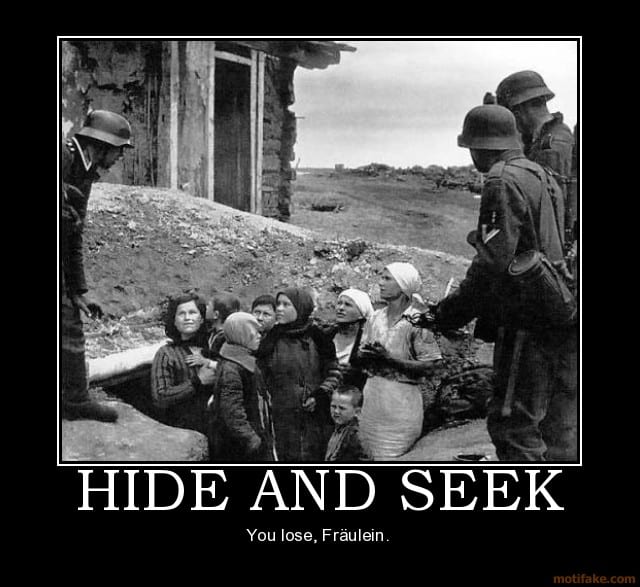
hide-and-seek-wwii-soldiers-nazi-german-women-rape-demotivational-poster-1246372387

(Unknown, 2008, cited inDemotivational Posters.)

If I remember correctly, years ago I was watching a performance where an actor accidently said “he was a good man” instead of “he wasn’t a good man”. The context of the text was a description of one of those genocidal dictators, which one it was I cannot remember.


However the accidental removal of the two letters ‘n’ & ‘t’ within his script, prompted me as an audience member, making me want to boldly stand up and say “no he wasn’t” in reply to this accidental comment. Since I as an audience member I didn’t know that this was a mistake, I felt that the writer and the actor were wrong and offensive.


After the performance I realised that it was a mistake, however I still thought about the situation. I thought about how one statement which was commonly accepted as immoral, offend me so much that I wanted to voice my opinion openly at that exact instance. Why didn’t I ever get excited when watching a political/social performance that I agreed with? Even though these types of performances entertained me, I never felt it was necessary to show/voice my exuberance in the same manner that I wanted to show/voice my disagreeance.


I believe this was because I agreed with these politically correct plays and thus they effectively voiced my own opinion which left me with no intellectual part to play. Because I didn’t need to process and make decisions based on the plays subject matter, I became docile.


Thus this is why I came up with the idea The Man You Hate which is a presentation of a, for lack of a better word, negative character. I do not want my audience to become somewhat docile because their views where compliant with my own. I personally feel that a great performance is one that gets a large and visual response from the audience, be it positive or negative.


I wish to play around with the presentation of horrific material in the same way the above image does as it conbines the lovable kids game of hide and seek with mortifying inevitable deaths.  This initial idea of The Man You Hate is, on the surface is a character who is homophobic, sexist and racist but is gleeful about his discussions and his vulgarity. While under this exterior, the performance hopes to negatively excite the audience and make them think deeper into these subjects. From this hopefully these social matters become discussed and thought about considerably more than what is being discussed at the moment.


Unknown. (2008) Hide and Seek WWII Soldiers Nazi. [online] Demotivational Posters. Available from http://www.demotivationalposters.org/facebookview.php?id=62406 [Accessed 23rd May 2014]